The intention of this post is to share my knowledge gained over three decades of working in, on and around ponds, waterfalls and water features. In which time I have used or dealt with most types of flexible pond lining and have ultimately seen which ones hold up and which ones are more likely to fail.
Why choose a flexible liner?
Their literal flexibility means they can conform to a complex or random pond profile. They are easily available, quick to install and user friendly. Choose carefully as quality varies between types.
What function does a flexible pond liner perform?
The liners job is purely to retain the desired water level. This is most important when designing a functional pond, pondless waterfall or water feature.
Types of flexible pond liner:
Liners come in a variety of materials which have different price points and characteristics.
Flexible membranes break down in to two main catagories:
Plastic liners such as LDPE, HDPE and PVC.
Rubberised liners including Butyl and EPDM.
Geosynthetic Clay Liners (GCL) are a third, which we will cover in another post.
A quick overview of some pros and cons of different flexible liner types:
LDPE: Advantages include it’s cheap and lightweight. Disadvantages are that it’s thin, and has questionable longevity.
HDPE: Advantages are better longevity and on site weld-ability making it a choice on larger or industrial builds. Disadvantages are its thicker and denser construction make it a more expensive and less flexible version.
PVC: Advantages include it’s mid range price, mid flexibility and it is repairable/seam-able. Disadvantages include longevity, it can be an inconsistent product. Is difficult to mould and fold in colder weather, easily torn in hot weather and is not very UV resistant.
Butyl: Advantages are that it is a rubber liner so very flexible and durable. Thicker is better. It is often specified by architects and designers as it is a traditional product. Disadvantage this comes at a higher cost.
EPDM: Advantages are it’s high quality and has great characteristics. Being highly elastic and moldable, foldable and seamable on site. It’s high puncture resistance and repairability are great. It can also be factory welded to a large size or shaped to fit. Disadvantages are that thicker liners come with a greater weight. Cost can be high and variable as market driven. Keep in mind value rather than cost.
Each type of liner can come in a range of thicknesses and possible finishes. A textured finish for example can allow for more flexibility or a subtler look but may make a liner thinner and as a result weaker.
Finishes can vary with polymers and other additives adjusting flexibility, UV, temperature and chemical resistance for example.
To learn more about other lining/construction methods watch out for another pond waterproofing post.
Types of Liner finish and Pond liner pricing:
‘A premium liner comes at a premium, and a cheap liner can cost you a lot more!’
When costing a pond liner it is important to budget for the best quality liner you can afford. Many people look at guarantee length as a sign of liner quality but this can be misleading.
Pond liner guarantee:
Most liners show a guarantee for the lifetime of the liner, often ranging from 10-40yrs. Not all liners are created equal but what does this mean if you need to make a claim? What if you have a legitimate liner issue and need to claim on the guarantee?
Keep in mind a long guarantee isn’t necessarily an indication of quality and longevity. It can show a willingness to replace the liner at a low cost.
Will they pay out? Generally you won’t get your money back but a new liner may be provided if you meet their criteria for a material or manufacturing failure. Over time your liner may be exposed to many variables that could invalidate your guarantee. Building your pond correctly can help protect your liner further. Keep in mind a replacement liner will not be fitted for you. It is a material replacement and doesn’t cover any labour or additional materials required. There will likely be considerable work involved in deconstructing and reconstructing a pond to fit a replacement liner. If you wish to make changes or enhancements during this process, you may need a different size or additional liner.
On a positive note if your liner has failed, this can be a great opportunity to have your pond redesigned and constructed to become the pond of your dreams.
Protective Membranes; Pond Underlay and Overlay:
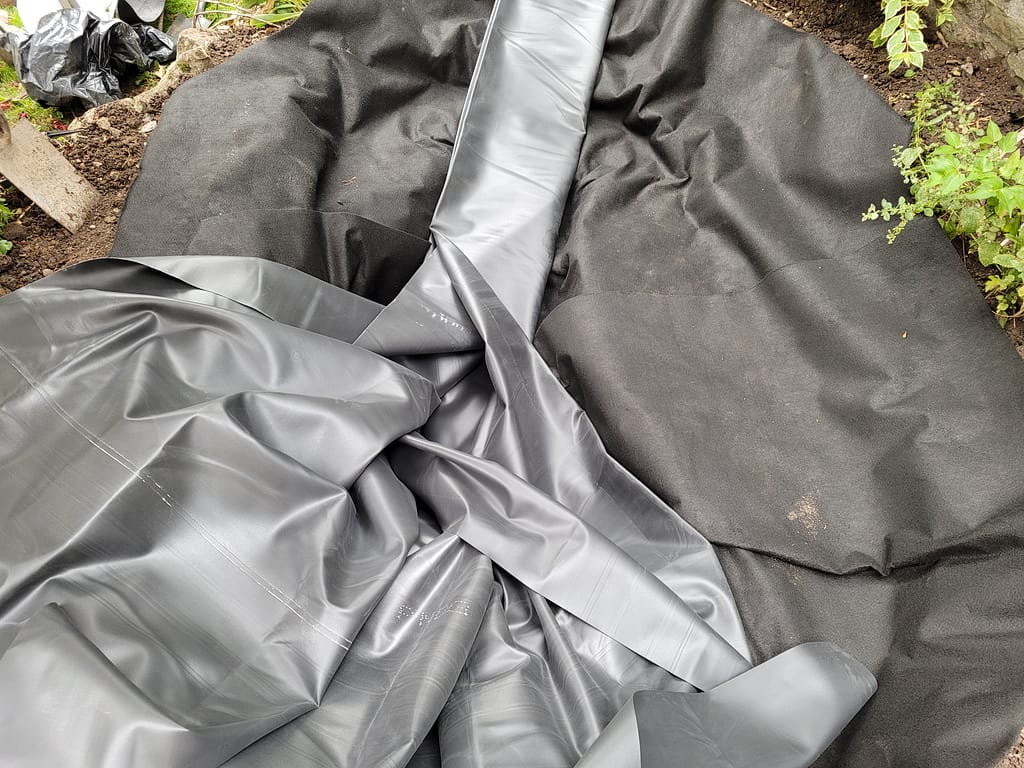
A protective layer that sits between the ground and the liner. Pond underlay membranes are measured in Grams/M² (GSM), a higher GSM represents a thicker more protective product.
We often refer to underlay as ‘cheap insurance’ in the pond industry as it protects from potential issues under the liner where it softens sharp edges and spreads weight if there is a void space below.

DIY underlays:
Carpet: Best avoided as it can breakdown and create a real mess under the liner.
Cardboard: Best avoided as it deteriorates and disappears over time.
Sand: Can be effective to level out and cushion flat surfaces. Sand is often rendered on to vertical surfaces, this is best avoided as the sand can migrate to the bottom over time. This creates a void at the top and a hump at the bottom which can cause liner issues.
A pond liner guarantee will often require the installation of a specific underlay.
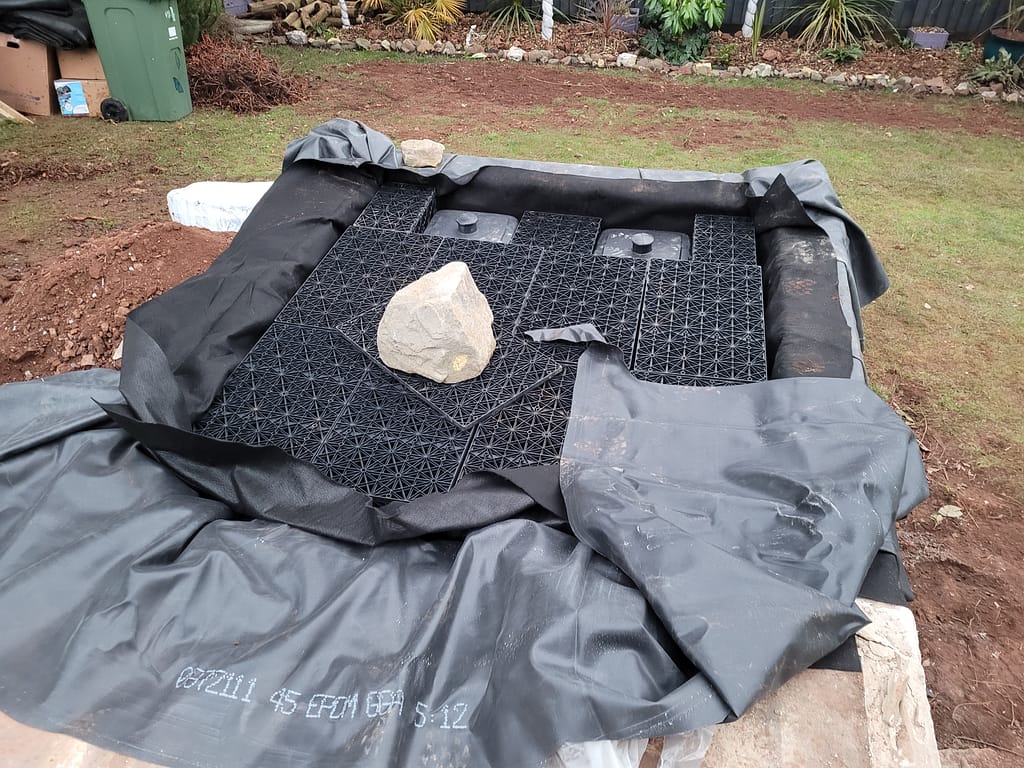
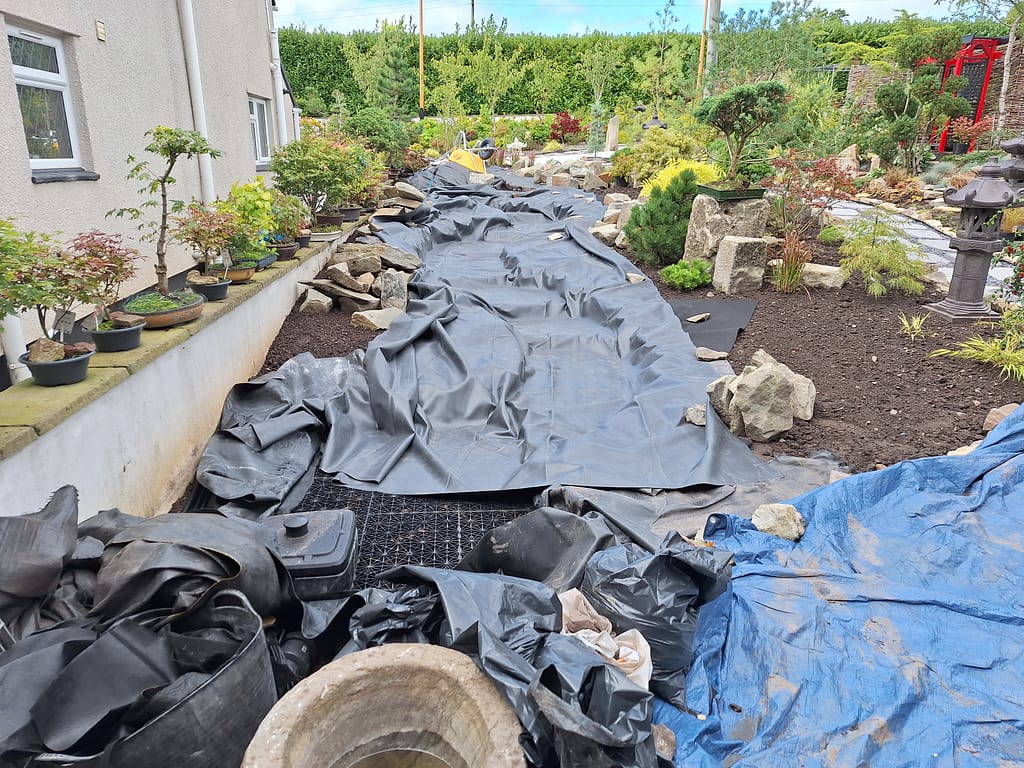
We construct our Ecosystem Ponds with protective underlay and overlay sandwiching the flexible liner. Additional layers are used as required alongside correct ground preparation to create the perfect base to build from.
Liner thickness. Why we choose 1mm EPDM:
We use 1mm smooth EPDM as it ticks all the boxes for us. It is good value, has exceptional durability, stretch and maleability, UV resistance, is easy to repair if an accident happens, is available in many pre-cut and roll sizes as-well-as factory welded bespoke sizes.

How we optimise liner longevity:
We design and construct our Ecosystem Ponds and Pondless Waterfalls following a strict process:
1. The ground is prepared; voids are filled and we remove stones, roots and sharp objects.
2. A heavy duty underlay is installed.
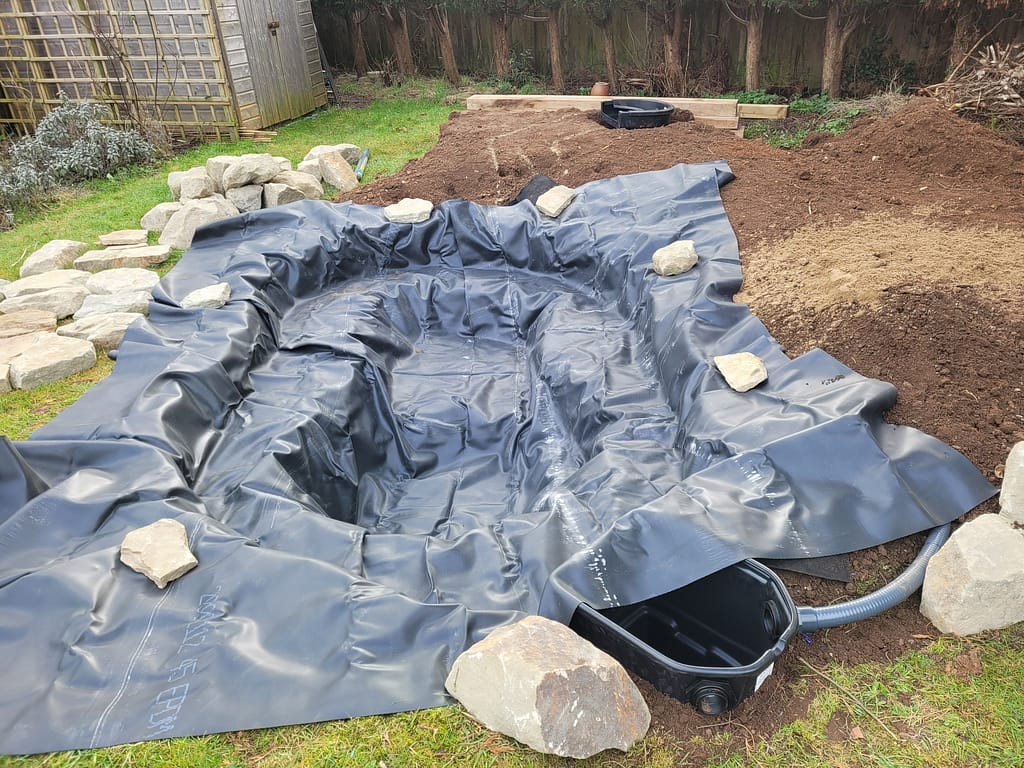
3. Our EPDM flexible pond liner is installed. We fold it in to place as required to alleviate any areas of stress.
4. We use a heavy duty overlay to protect the top surface of the liner.
5. The pond is clad with stone boulders, natural timber and then dressed with pebble.
6. The pond is completed with the addition of plants, fish and water.
This gives our premium liners the optimum conditions to ensure a long and trouble free service life.
How to estimate liner and underlay sizes:
To estimate liner size:
- Take pond length and add twice the depth then add 0.6m = Dimension 1.
- Now take the pond width, add twice the depth, then add 0.6m = Dimension 2.
- Now you can order a liner of minimum size: Dimension 1 by Dimension 2 (as above).
Example:
Our pond is 3m x 2m across and 0.6m deep.
- Determine the dimemsions:
- Dimension 1, pond length = 3m,
- Dimension 2, pond width = 2m,
- Depth, pond depth = 0.6m.
- Add the depth:
- Pond length + 2× pond depth = 4.2m,
- Pond width + 2× pond depth = 3.2m.
- Add the overlap at 0.6m to each dimension:
- Pond length 4.2m + 0.6m overlap = 4.8m.
- Pond width 3.2m + 0.6m overlap = 3.8m.
Our liner size will be 4.8m x 3.8m.
To determine how much underlay you need; simply multiply these dimensions:
Ie 4.8m x 3.8m = 18.24m². Rounding down to 18m² is fine. Double this figure to add overlay.
In conclusion:
We choose and recommend EPDM liners at 1mm thick with a smooth finish. The properties of our high quality EPDM liners in conjunction with heavy duty protective membranes and our construction methodology allow us great freedom to create bespoke ponds, waterfalls and water features with the reassurance that they will endure and provide the longevity we expect.